Peer Review of the 492-Participant Dataset to Evaluate the Proposed Baseline Phenotype – Standard Body Type One/BT1 (None to Minimal Skinny Fat)
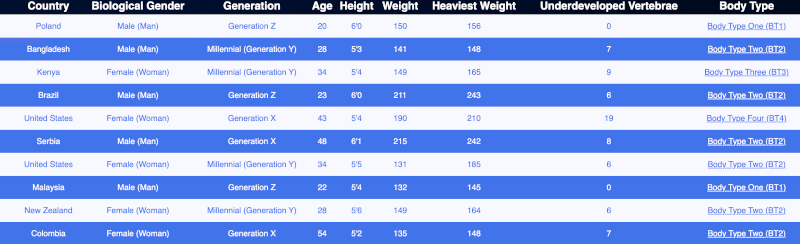
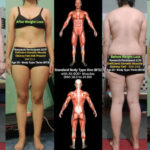
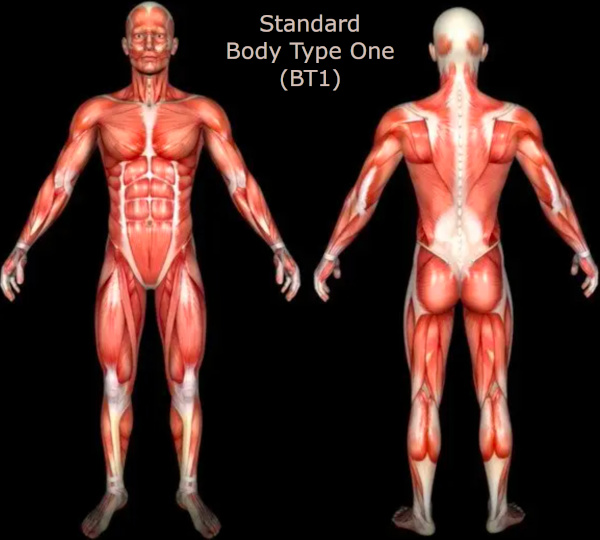 We are working on a peer review paper to evaluate the proposed standardized baseline phenotype — the Standard Body Type One (BT1) (none to minimal skinny fat) derived from the authoritative anatomical model (1) — using the 492‑participant dataset (2). The analysis will test whether individuals classified as BT1 exhibit a reproducible pattern of anatomical and phenotypic characteristics within the dataset, providing an empirical assessment of the proposed baseline phenotype.
Meaningful classification requires a defined reference standard. Although the conventional anatomical model depicts the complete human body structure and musculature — including 600+ muscles — it has never been formalized as an official baseline phenotype. No standardized phenotype currently exists for defining normal human muscular structure or body shape, nor for quantitatively comparing individuals, even though human body shapes and sizes vary widely.
By contrast, blood pressure, bone density, cholesterol, and A1c all have standardized reference ranges against which variation can be classified. These ranges enable consistent interpretation, clinical decision‑making, and population‑level comparison. Social descriptors — somatotypes (mesomorph, ectomorph, endomorph), apple, pear, hourglass, triangle, rectangle, round, and other non‑standardized body‑shape descriptors — attempt to describe differences in human body shape, but they do not provide standardized scientific measurement. They lack anatomical grounding, quantitative criteria, and reproducible classification rules. Without a defined baseline phenotype, science has no standardized biological reference for muscular structure or body shape.
Standard Body Type One/BT1 (None to Minimal Skinny Fat) – Peer Review of the 492-Participant Dataset to Evaluate the Proposed Baseline Phenotype
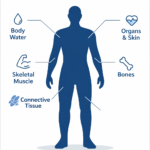
Muscle (3) — a primary metabolic and structural driver — is central to metabolism, body composition and shape, movement, athletic capacity, diet effects, exercise response, aging trajectories, and overall health. Muscle tissue also plays a critical role in glucose uptake, insulin sensitivity, energy expenditure, and metabolic regulation, making it highly relevant to conditions such as insulin resistance, type 2 diabetes, and obesity. Yet, as described by Heymsfield et al. (4), no gold‑standard, standardized measurement exists for total muscle tissue, and no population reference baseline has been established for interpreting such a measurement.
This leaves a glaring measurement‑science gap in body composition, accurate human health assessment, and real‑world solutions that actually work. Existing proxy tools were not designed to — and cannot — define a baseline phenotype. DEXA (6) measures bone density and lean mass (a composite of all non‑fat tissue) but cannot distinguish muscle shape, distribution, or genetically influenced structure. CT scans expose individuals to radiation, preventing their use for population‑level baselines. Anthropometric indicators (7, 8, 9) — including BMI (height and weight to estimate body fat), body‑fat percentage, waist‑to‑hip ratio, and waist‑to‑height ratio — cannot resolve anatomical structure or determine true body composition, as they do not measure muscle, directly or indirectly.
The Solution – A Baseline Phenotype
A baseline phenotype for muscular structure would fill this measurement gap by providing:
- A standardized anatomical reference — a biologically grounded model for normal muscular structure
- A quantitative basis for classification — enabling reproducible measurement across individuals and populations
- A reproducible comparison framework — allowing consistent interpretation of muscular variation
- A foundation for future measurement research — including accurate MRI‑based measurement of genetically influenced total muscle tissue and a baseline average against which such measurements can be compared
If peer review identifies limitations in the proposed BT1 baseline phenotype that require further validation through MRI, we will adjust the initial MRI Study (5) design as necessary to address those requirements.
References
- Britannica: human muscle system, Shane W. Cummings and Robin Huw Crompton (Fact-checked by the Editors of Encyclopaedia Britannica. https://www.britannica.com/science/human-muscle-system
- Fellow One Research: Body Type Science Research Data. https://fellowone.com/category/fellow-one-research/the-four-body-types/body-type-science/body-type-quiz/research-data/
- Skinny Fat Science: Is Muscle/Mass Genetic and How Does It Affect Skinny Fat?, November 20, 2024. https://skinnyfat.fellowone.com/skinny-fat-science/is-muscle-mass-genetic-and-how-does-it-affect-skinny-fat/
- NIH, National Library of Medicine: Ethnicity-Related Skeletal Muscle Differences Across the Lifespan, January-February 2010, Analiza M Silva, Wei Shen, Moonseong Heo, Dympna Gallagher, Zimian Wang, Luis B Sardinha, and Steven B Heymsfield. https://pmc.ncbi.nlm.nih.gov/articles/PMC2795070/
- Skinny Fat Science: Scientific Skinny Fat MRI Study – Proving What Skinny Fat Is, March 26, 2025. https://skinnyfat.fellowone.com/skinny-fat-science/scientific-skinny-fat-mri-study-proving-what-skinny-fat-is/
- Skinny Fat Science: What Body Fat Percentage Is Skinny Fat?, July 16, 2025. https://skinnyfat.fellowone.com/skinny-fat-science/what-body-fat-percentage-is-skinny-fat/
- Skinny Fat Science: What is Skinny Fat?, July 26, 2024. https://skinnyfat.fellowone.com/skinny-fat-science/what-is-skinny-fat/
- Skinny Fat Science: The Importance of a Standardized Baseline Phenotype to Determine Deficient Muscle (Skinny Fat), September 9, 2026. https://skinnyfat.fellowone.com/skinny-fat-science/the-importance-of-a-standardized-baseline-phenotype-to-determine-deficient-muscle-skinny-fat/
- Skinny Fat Science: How Skinny Fat Affects GLP-1 (Ozempic) Weight Loss & Muscle Mass, October 16, 2024. https://skinnyfat.fellowone.com/skinny-fat-science/how-skinny-fat-affects-glp-1-ozempic-weight-loss-muscle-mass/
Was this article helpful?
Related Posts
What Is Skinny Fat?
How to Fix Skinny Fat

The Best Skinny Fat Diet, According to Science

Popular Concepts
- Skinny Fat: “Thin Fat”, Cellulite, and Deficient Muscle

- Lean Body Mass (LBM) and Skinny Fat
- What Body Fat Percentage Is Skinny Fat?
- Skinny Fat Body Composition – Before & After Weight Loss
- Skinny Fat & Insulin Resistance
- Body Dysmorphia and Skinny Fat Including Anorexia & Other Eating Disorders
- How Skinny Fat Affects Body Shape
- Skinny Fat Is More Than Just Normal-Weight Obesity