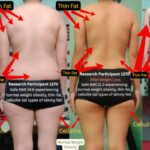
New 500-Participant Dataset To Evaluate the Proposed Standardized Baseline Phenotype – Skinny Fat Classification
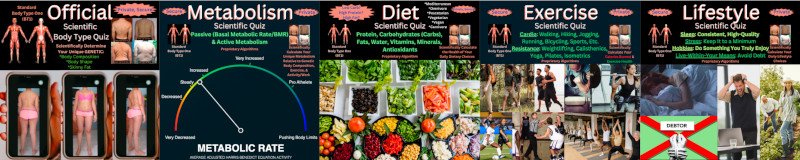
Our proof-of-concept 492-participant dataset (1) has served its purpose well. From it, we have been able to rebuild our scientific assessment tools — what we call the Scientific Health Quizzes — including the Scientific Body Type Quiz to test the proposed Standard Body Type One (BT1) standardized baseline phenotype and classification framework, along with the Scientific Metabolism, Diet, Exercise, and Lifestyle Quizzes. These assets allow us to more accurately screen the required cohort for our new 500-participant dataset to test the proposed Standard Body Type One (BT1) standardized baseline phenotype and classification framework and write the peer-review manuscript. Five hundred participants produce a robust dataset for statistical analysis and peer-reviewed publication.
Without a standardized baseline phenotype and classification framework, large amounts of human variation remain structurally unclassified. We can roughly describe body shape, measure height and weight (BMI)(2), estimate body composition (lean body mass, LBM)(3), and assign broad categories, but we lack an accurate standardized biological reference or direct total muscle measurement framework for understanding how individual differences in structure, composition, and muscular development relate to physical function and health.
Skinny Fat Classification – New 500-Participant Dataset To Evaluate the Proposed Standardized Baseline Phenotype
Identifying variation and establishing a scientific biological reference for understanding and interpreting variation are different things. Descriptors such as apple, pear, triangle, rectangle, hourglass, and somatotypes arbitrarily describe and visibly identify different body shapes. Anthropometric and body composition proxies (BMI, LBM) offer indirect measurement estimates and rough classifications to identify differences. However, none of those provide a baseline for reference or scientifically establish and explain the underlying biological structures producing those differences.
What happens when an institution makes decisions about a biological characteristic without a standardized reference framework? BMI brought the phenotype-classification blind spot into focus: for an individual to be scientifically classified relative to a biological standard, there must first be a defined standardized reference against which to compare that individual. Yet a standardized baseline phenotype doesn’t exist. Although anatomy science relies on the established yet unofficial anatomical model of the complete human body with all 600+ muscles.
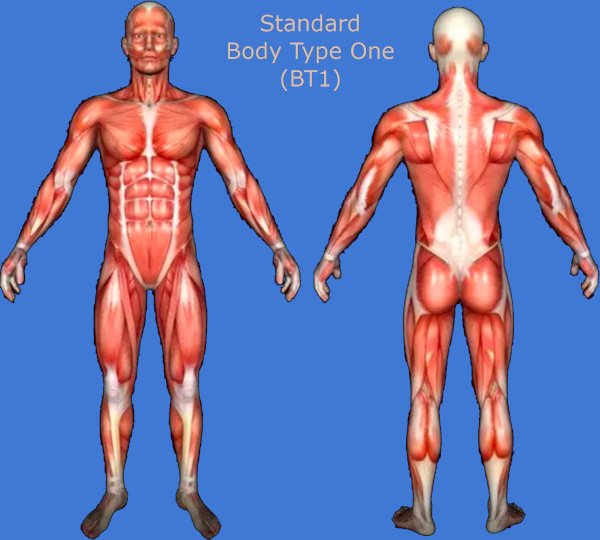
That established standard anatomical model with all 600+ muscles (4) provides the scientifically grounded starting point because it represents the structural organization of the complete human body. When a person visits a doctor, their physical structure is evaluated against this established model to identify deviations, abnormalities, or pathology. But the anatomical model describes the common structural organization of the human body; it doesn’t explain the large biological variation that exists within that organization. It tells us what structures humans have, but not how those structures vary in development across individuals, what constitutes a baseline for that variation, or how differences in their development produce differences in body shape, composition, and physical capacity. The existence of the anatomical model, therefore, doesn’t eliminate the need for a standardized baseline phenotype—it establishes the structural foundation from which such a phenotype can be investigated.
Why is There No Standardized Baseline Phenotype?
Blood pressure, like muscular development, varies significantly across individuals, yet we don’t say, “Why do we need blood pressure reference ranges?” On the contrary, standardized clinical reference ranges allow that variation to be measured, classified, and interpreted. Normal adult blood pressure is defined (5) by the American Heart Association (AHA) and American College of Cardiology (ACC) as being below 120/80 mmHg. Without this established reference, clinicians wouldn’t have a common baseline against which to compare and interpret individual measurements and variation. How would anyone know if their blood pressure is healthy?
Muscle (6) directly affects metabolism, glucose uptake, insulin, movement, physical function, body composition, and health. Yet people routinely encounter differences in body shape and composition that the current proxy tools (BMI, LBM, etc.) and descriptors cannot adequately explain. A person may properly alter their lifestyle and lose weight, but still be unable to achieve the health status and/or body shape that another person achieves with ease. These differences can also affect body image (7) and mental health (8). What accounts for the differences?
An official standardized baseline phenotype establishes a common biological reference for understanding differences in body structure, shape, muscular development, and composition across individuals and populations. It provides the missing foundation for investigating the differences. The 492-participant proof-of-concept dataset laid the groundwork for building a new 500-participant dataset using the newly developed assessment tools to evaluate the proposed BT1 classification, inform subsequent MRI research (9), and advance science policy.
New 500-Participant Dataset
What’s missing is a standardized framework for determining a baseline phenotype. This information is fundamental to understanding an individual’s metabolism, structure, physical capacity, and health. Instead, two people with the same BMI but substantially different natural underlying phenotypes—one with significantly more natural muscle and one with significantly less—can receive the same standardized classification, guidance, and general strategy despite fundamentally different body compositions, metabolic characteristics, and physical capacities. They can follow the same diet, exercise, and lifestyle protocol yet experience dramatically different results.
This directly affects science policy, particularly clinician assessment, diagnosis, prognosis, and patient health. When the existing framework cannot directly measure and explain the underlying biological differences, the explanation is all too often pushed back onto the individual: their failure is attributed to personal shortcomings rather than the possibility of underlying biological differences. The absence of a standardized baseline phenotype and classification range is too often treated as irrelevant to these differences, when it’s directly relevant.
BT1 isn’t proposed as another arbitrary body-shape category, but as an empirical phenotype corresponding to the established anatomical model. While this anatomical model serves as a foundational reference throughout science and medicine, it’s never been formally evaluated as a standardized baseline phenotype. The central question isn’t whether human bodies vary—they clearly do—but whether the established anatomical reference corresponds to a reproducible empirical pattern in real individuals. The proposed BT1 baseline phenotype operationalizes that anatomical model as a testable classification hypothesis:
If BT1 corresponds to a reproducible phenotype pattern aligned with the standard anatomical model, then BT1-classified individuals should exhibit a coherent and empirically consistent set of objective anatomical indicators within a new research participant dataset.
The Classification Framework – Skinny Fat
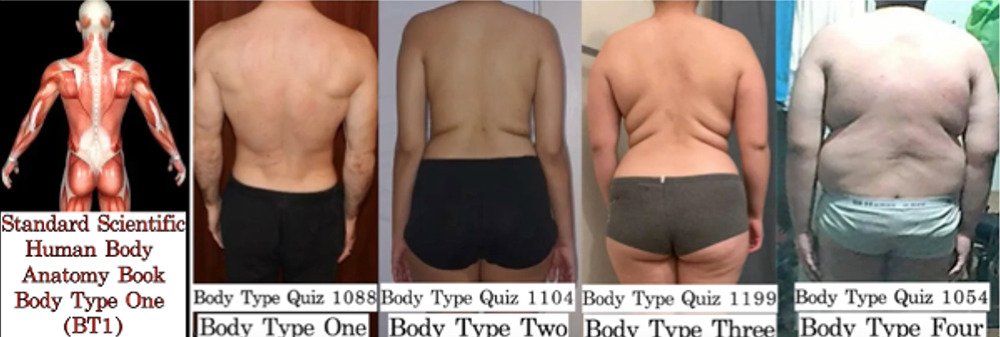
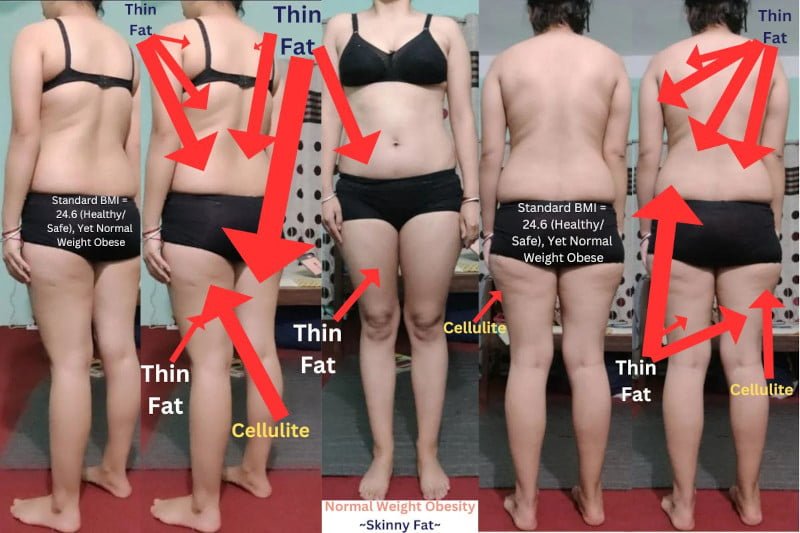
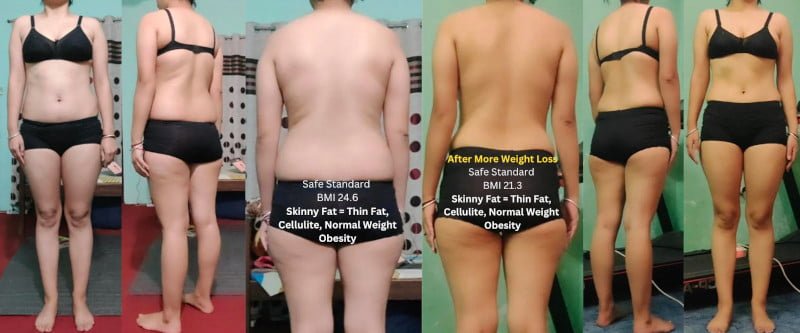
The Scientific Body Type Quiz utilizes the standard anatomical model with all 600+ muscles — what our research calls the Standard Body Type One (BT1) and proposes as the standardized baseline phenotype — to estimate if you are experiencing deficient genetically-influenced muscle (what our research calls skinny fat)(10), and its severity; IE none to minimal skinny fat, slight to moderate skinny fat, moderate-high to severe skinny fat, very severe to extreme skinny fat.
Proposed Standard Body Type One (BT1) = none to minimal skinny fat (deficient genetically-influenced muscle)
Proposed Body Type Two (BT2) = slight to moderate skinny fat (deficient genetically-influenced muscle)
Proposed Body Type Three (BT3) = high-moderate to severe skinny fat (deficient genetically-influenced muscle)
Proposed Body Type Four (BT4) = very severe to extreme skinny fat (deficient genetically-influenced muscle)
References
- Fellow One Research: Body Type Science Research Data. https://fellowone.com/category/fellow-one-research/the-four-body-types/body-type-science/body-type-quiz/research-data/
- Skinny Fat Science: Skinny Fat is a Lack of Genetic Muscle – Beyond Normal-Weight Obesity, August 13, 2025. https://skinnyfat.fellowone.com/skinny-fat-science/skinny-fat-is-a-lack-of-genetic-muscle-beyond-normal-weight-obesity/
- Skinny Fat Science: Lean Body Mass (LBM) and Skinny Fat, June 3, 2026. https://skinnyfat.fellowone.com/skinny-fat-science/lean-body-mass-lbm-and-skinny-fat/
- Britannica: human muscle system, Shane W. Cummings and Robin Huw Crompton (Fact-checked by the Editors of Encyclopaedia Britannica. https://www.britannica.com/science/human-muscle-system
- Skinny Fat Science: Why Is There No Standardized Baseline Phenotype to Understand Muscle Deficiency (Skinny Fat)?, September 23, 2026. https://skinnyfat.fellowone.com/skinny-fat-science/why-is-there-no-standardized-baseline-phenotype-to-understand-muscle-deficiency-skinny-fat/
- Skinny Fat Science: Is Muscle/Mass Genetic and How Does It Affect Skinny Fat?, November 20, 2024. https://skinnyfat.fellowone.com/skinny-fat-science/is-muscle-mass-genetic-and-how-does-it-affect-skinny-fat/
- Skinny Fat Science: How Skinny Fat Affects Body Shape, April 16, 2025. https://skinnyfat.fellowone.com/skinny-fat-science/how-skinny-fat-affects-body-shape/
- Skinny Fat Science: How Skinny Fat Affects Mental Health, August 21, 2024. https://skinnyfat.fellowone.com/skinny-fat-science/how-skinny-fat-affects-mental-health/
- Skinny Fat Science: Scientific Skinny Fat MRI Study – Proving What Skinny Fat Is, March 6, 2025. https://skinnyfat.fellowone.com/skinny-fat-science/scientific-skinny-fat-mri-study-proving-what-skinny-fat-is/
- Skinny Fat Science: What Is Skinny Fat?, July 26, 2024. https://skinnyfat.fellowone.com/skinny-fat-science/what-is-skinny-fat/
Was this article helpful?
Related Posts
What Is Skinny Fat?
How to Fix Skinny Fat

The Best Skinny Fat Diet, According to Science

Popular Concepts
- Skinny Fat: “Thin Fat”, Cellulite, and Deficient Muscle
- Lean Body Mass (LBM) and Skinny Fat
- What Body Fat Percentage Is Skinny Fat?

- Skinny Fat Body Composition – Before & After Weight Loss
- Skinny Fat & Insulin Resistance
- Body Dysmorphia and Skinny Fat Including Anorexia & Other Eating Disorders

- How Skinny Fat Affects Body Shape

- Skinny Fat Is More Than Just Normal-Weight Obesity