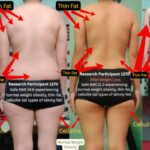
Can I Have Skinny Fat But Not Be Experiencing Normal-Weight Obesity? – Skinny Fat Question
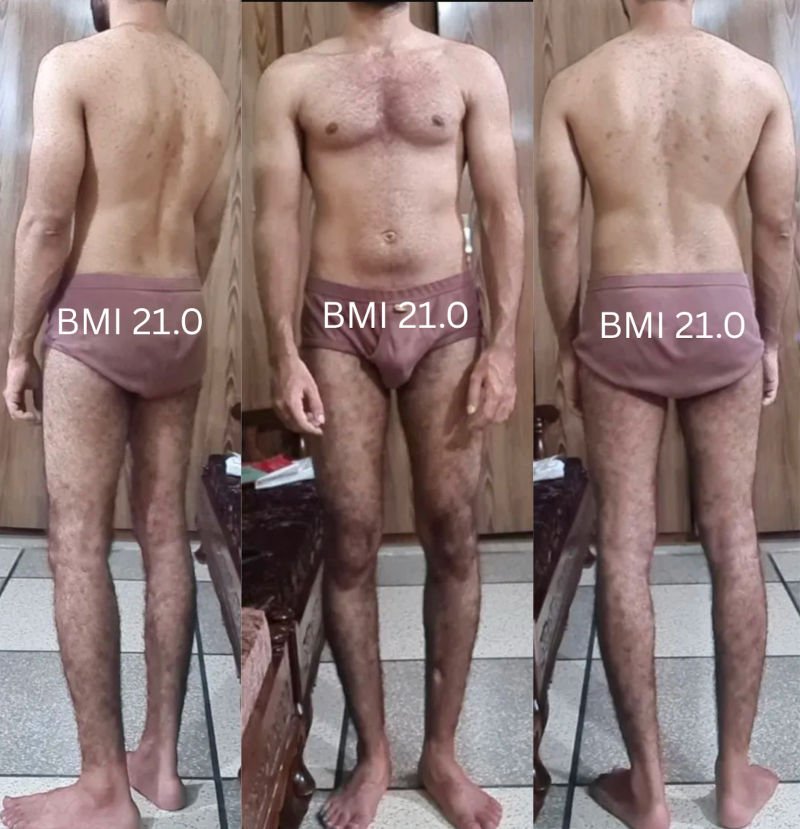
 Greetings, Dr. Skinny Fat. I’m confused about normal-weight obesity, or what some people call skinny fat. My BMI is 21, and my doctor told me that I am not normal-weight obese – what they say is too much fat within a normal-weight BMI. But I am quite sure that I have some skinny fat on my abdomen and love handles where I should have muscle.
After reviewing your site, I think what I am experiencing is what your research calls thin fat. I compare my body to your Body Type One (BT1), and I’m certain that I have deficient muscle on my abdomen and love handles. I don’t think losing any more weight is going to reveal the muscle I should have in those areas. My diet, exercise, and lifestyle could be better, and I can’t rule out that I lost some muscle.
However, I don’t think I ever had the full muscle according to the BT1. When I was younger, I didn’t have it. It would be nice if there were some way to measure all this, but my doctor told me there is no standardized way to measure muscle at birth. If I don’t know how much muscle I started with, how can I know how much I have now, or ever?
Can I Have Skinny Fat But Not Be Experiencing Normal-Weight Obesity? – Skinny Fat Question
Because there is no standardized baseline phenotype and no standardized way to measure total muscle tissue at birth, or ever, there is no way to accurately know your natural, genetically-influenced total baseline starting muscle tissue. And without a population baseline to compare such a measurement to, you cannot know if your natural baseline muscle is average, above average, or below average. The “standard” BMI (1, 4) and lean body mass (LBM)(2) do not and cannot offer this information — neither directly measures muscle tissue. Moreover, without standardized baselines, there is no way to accurately track and know how much muscle you may have gained via resistance/exercise or lost due to atrophy from poor diet, exercise, and lifestyle, or sarcopenia from aging.
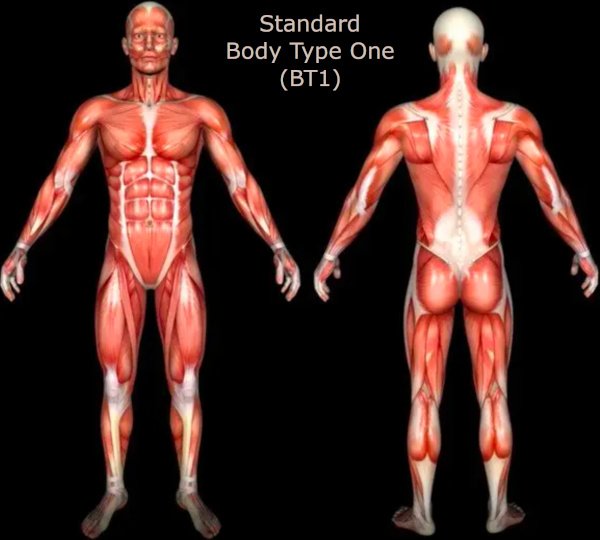 However, comparing your body to the unofficial standard anatomical model with all 600+ muscles (3)—as you mentioned, what our research calls the Standard Body Type One (BT1) and proposes as the standardized baseline phenotype—can help you better understand your unique genetics, including body structure and composition. If you are confident that you never had all 600+ muscles fully developed from day one, and you are confident that you are experiencing what our research calls thin fat skinny fat (4) on your abdomen and love handles, then it is likely you are experiencing genetically-deficient muscle tissue in those areas.
Of course, the only way to really know is to accurately measure with an MRI scan. However, to do that, we first need to establish a standardized baseline phenotype and classification framework, a standardized total muscle tissue measurement, and a standardized population baseline. These are accomplished via our research, including our MRI Study (5). But we cannot successfully achieve these goals without funding help.
Building A New Dataset – Normal-Weight Obesity/Skinny Fat
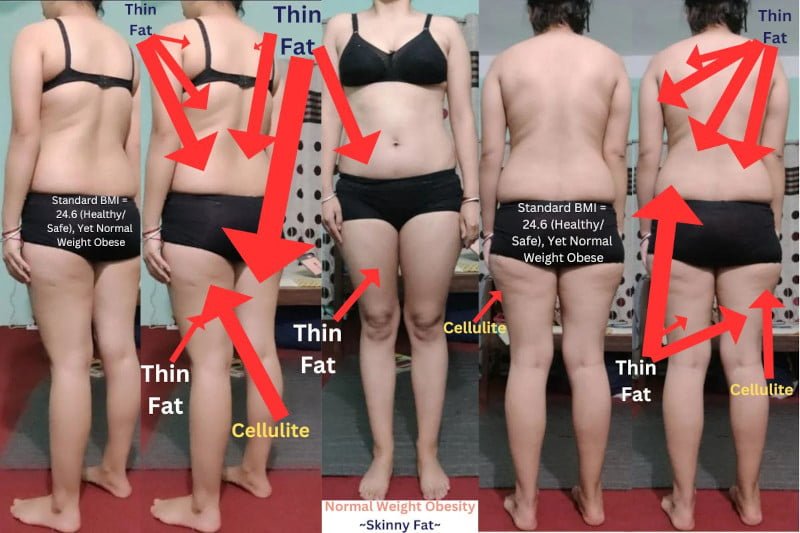
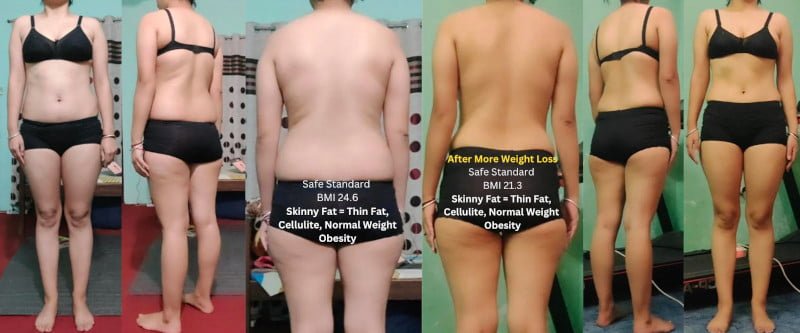
In terms of normal-weight obesity, our research indicates that one can, indeed, not be normal-weight obese yet still be experiencing skinny fat (deficient genetically-influenced muscle)(4). We directly challenge the existing normal-weight obesity definition (6, 4) as a blatant and unacceptable contradiction (7, 6, 4) to the established and accepted BMI. A foundational premise of our nearly 25 years of scientific research is that skinny fat is not too much body fat (regular white/yellow adipose tissue) within normal-weight BMI, nor is it too much visceral fat. Skinny fat is deficient genetically-influenced muscle that is only subcutaneous (4).
Our proof-of-concept 492-participant dataset (8) has served its purpose well. From it, we have been able to rebuild our scientific assessment tools — what we call the Scientific Health Quizzes — including the Scientific Body Type, Metabolism, Diet, Exercise, and Lifestyle Quizzes. These assets allow us to more accurately screen the required cohort for our new 500-participant dataset (9).
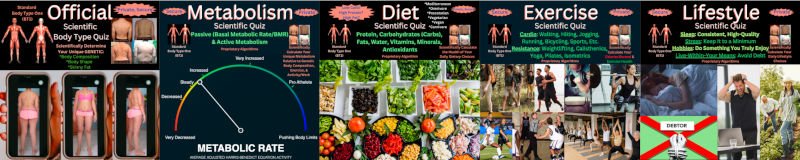
Along with a properly recruited expert scientific team to build the protocol and methodology to process and analyze the new data, we will develop the scientific record and submit the manuscript for official peer review. We can only do this with sufficient resources. Please spread the word and tell your colleagues, friends, and family about our research.
References
- Skinny Fat Science: Why BMI Fails Skinny Fat Bodies, October 29, 2025. https://skinnyfat.fellowone.com/skinny-fat-science/why-bmi-fails-skinny-fat-bodies/
- Skinny Fat Science: Lean Body Mass (LBM) and Skinny Fat, June 3, 2026. https://skinnyfat.fellowone.com/skinny-fat-science/lean-body-mass-lbm-and-skinny-fat/
- Britannica: human muscle system, Shane W. Cummings and Robin Huw Crompton (Fact-checked by the Editors of Encyclopaedia Britannica. https://www.britannica.com/science/human-muscle-system
- Skinny Fat Science: What Is Skinny Fat?, July 26, 2024. https://skinnyfat.fellowone.com/skinny-fat-science/what-is-skinny-fat/
- Skinny Fat Science: Scientific Skinny Fat MRI Study – Proving What Skinny Fat Is, March 26, 2025. https://skinnyfat.fellowone.com/skinny-fat-science/scientific-skinny-fat-mri-study-proving-what-skinny-fat-is/
- Skinny Fat Science: Skinny Fat is a Lack of Genetic Muscle – Beyond Normal-Weight Obesity, April 13, 2025. https://skinnyfat.fellowone.com/skinny-fat-science/skinny-fat-is-a-lack-of-genetic-muscle-beyond-normal-weight-obesity/
- Skinny Fat Science: Skinny Fat Is More Than Just Normal-Weight Obesity, April 2, 2025. https://skinnyfat.fellowone.com/skinny-fat-science/skinny-fat-is-more-than-just-normal-weight-obesity/
- Fellow One Research: Body Type Science Research Data. https://fellowone.com/category/fellow-one-research/the-four-body-types/body-type-science/body-type-quiz/research-data/
- Skinny Fat Science: Building a Scientific Skinny Fat Dataset, November 11, 2026. https://skinnyfat.fellowone.com/skinny-fat-science/building-a-scientific-skinny-fat-dataset/
Was this article helpful?
Related Posts
What Is Skinny Fat?
How to Fix Skinny Fat

The Best Skinny Fat Diet, According to Science

Popular Concepts
- Skinny Fat: “Thin Fat”, Cellulite, and Deficient Muscle
- Lean Body Mass (LBM) and Skinny Fat
- What Body Fat Percentage Is Skinny Fat?

- Skinny Fat Body Composition – Before & After Weight Loss
- Skinny Fat & Insulin Resistance
- Body Dysmorphia and Skinny Fat Including Anorexia & Other Eating Disorders

- How Skinny Fat Affects Body Shape

- Skinny Fat Is More Than Just Normal-Weight Obesity