Comparing MuscleMap to Our MRI Study to Identify Deficient Muscle Tissue (Skinny Fat)

 The MuscleMap (1, 2) project involving Northwestern University, the University of Sydney, Stanford, and a global consortium of collaborating research institutions is impressive and represents meaningful progress in automated muscle segmentation. However, it is important to clarify that MuscleMap and our MRI Study (3) are addressing different scientific problems.
After reviewing MuscleMap’s published work and current project objectives, the available evidence indicates that the platform extends beyond automated muscle segmentation to include normative modeling of measured muscle characteristics using demographic and anthropometric variables. This is an important advance in population-referenced muscle measurement. However, the science is clear that muscle is genetic and highly heritable (4) — has MuscleMap established a standardized baseline for total muscle tissue using a carefully selected reference population?
No, it has not. No such measurement exists at this time.
Comparing MuscleMap to Our MRI Study to Identify Deficient Muscle Tissue (Skinny Fat)
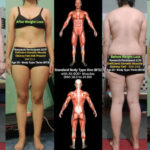
Our MRI Study addresses this specific gap by developing an accurate measurement of total genetically influenced muscle tissue through a carefully selected, standardized young-adult university cohort to establish a population baseline average. This baseline provides a standardized reference against which individual measurements can subsequently be compared, allowing individuals to be quantitatively classified as below average (skinny fat), average, or above average in total muscle tissue. The underlying hypothesis is that variation in total muscle tissue is measurably influenced by genetic muscle endowment.
 Thus, MuscleMap and our MRI Study address overlapping but distinct layers of the measurement problem: MuscleMap provides an important measurement and normative-modeling infrastructure, while our MRI Study focuses on establishing a direct population reference framework for genetically influenced total muscle tissue.
Our protocol utilizes specific screening tools, already developed and ready to go, to carefully select a narrow cohort of approximately 18-to-22-year-olds, with the upper age limit extended to 25 if necessary. The screening process is designed to minimize acquired influences on muscle quantity, including resistance or cardio exercise, poor diet, prolonged sedentary behavior, inadequate sleep, significant stress, and other lifestyle factors. By controlling these variables as carefully as possible within the reference cohort, the study is designed to better isolate genetically influenced variation in muscle quantity and establish a population baseline average. This framework will establish an objective baseline for genetically influenced total muscle tissue against which individual measurements can be compared, allowing individuals with measurably below-baseline muscle tissue (skinny fat) to be quantitatively identified.
Further Details
Indications are that MuscleMap’s current infrastructure involves multi-site whole-body MRI research, which faces substantial practical constraints, including protocol harmonization, IRB coordination, recruitment, scanner availability, and institutional logistics.
Whereas our study utilizes a single university MRI platform and a standardized acquisition protocol, enabling a controlled population baseline to be established from a cohort of approximately 400 to 850 participants, depending on funding.
In short:
MuscleMap develops AI/computer-vision tools for automated muscle segmentation, quantitative muscle mapping, and normative modeling of muscle measurements from medical imaging.
Our MRI Study is focused on developing the first population-level measurement and reference framework needed to interpret total genetically influenced muscle tissue against a standardized baseline.
The two projects are therefore complementary rather than competitive. In fact, our MRI Study can complement MuscleMap’s technical infrastructure. A robust, standardized population baseline for total genetically influenced muscle tissue can provide the missing reference framework for normative modeling, allowing automated segmentation technologies such as MuscleMap’s to place individual measurements against a defined population baseline.
References
- NIH, National Library of Medicine: MuscleMap: An Open-Source, Community-Supported Consortium for Whole-Body Quantitative MRI of Muscle, Ocotber 22, 2024. Marnee J McKay, Kenneth A Weber , Evert O Wesselink, Zachary A Smith, Rebecca Abbott, David B Anderson, Claire E Ashton-James, John Atyeo, Aaron J Beach, Joshua Burns, Stephen Clarke, Natalie J Collins, Michel W Coppieters, Jon Cornwall, Rebecca J Crawford, Enrico De Martino, Adam G Dunn, Jillian P Eyles, Henry J Feng, Maryse Fortin, Melinda M Franettovich Smith, Graham Galloway , Ziba Gandomkar, Sarah Glastras , Luke A Henderson, Julie A Hides, Claire E Hiller, Sarah N Hilmer , Mark A Hoggarth, Brian Kim , Navneet Lal, Laura LaPorta, John S Magnussen, Sarah Maloney, Lyn March, Andrea G Nackley, Shaun P O’Leary, Anneli Peolsson, Zuzana Perraton, Annelies L Pool-Goudzwaard, Margaret Schnitzler, Amee L Seitz, Adam I Semciw, Philip W Sheard, Andrew C Smith, Suzanne J Snodgrass, Justin Sullivan, Vienna Tran, Stephanie Valentin, David M Walton, Laurelie R Wishart, and James M Elliott. https://pubmed.ncbi.nlm.nih.gov/39590726/
- GitHub: MuscleMap: An Open-Source, Community-Supported Consortium for Whole-Body Quantitative MRI of Muscle. https://github.com/MuscleMap/MuscleMap
- Skinny Fat Science: Scientific Skinny Fat MRI Study – Proving What Skinny Fat Is, March 26, 2025. https://skinnyfat.fellowone.com/skinny-fat-science/scientific-skinny-fat-mri-study-proving-what-skinny-fat-is/
- Skinny Fat Science: Is Muscle/Mass Genetic and How Does It Affect Skinny Fat?, November 20, 2024. https://skinnyfat.fellowone.com/skinny-fat-science/is-muscle-mass-genetic-and-how-does-it-affect-skinny-fat/
Was this article helpful?
Related Posts
What Is Skinny Fat?
How to Fix Skinny Fat

The Best Skinny Fat Diet, According to Science

Popular Concepts
- Skinny Fat: “Thin Fat”, Cellulite, and Deficient Muscle

- Lean Body Mass (LBM) and Skinny Fat
- What Body Fat Percentage Is Skinny Fat?
- Skinny Fat Body Composition – Before & After Weight Loss
- Skinny Fat & Insulin Resistance
- Body Dysmorphia and Skinny Fat Including Anorexia & Other Eating Disorders
- How Skinny Fat Affects Body Shape
- Skinny Fat Is More Than Just Normal-Weight Obesity