Beyond the Number on the Scale: How a Genetic Muscle Deficiency (Skinny Fat) Impacts Metabolism and Health

 The holiday season typically involves celebration that includes excess consumption of food and drink, which ultimately leads to unwanted regular white/yellow fat weight gain for many people. Yet, most of us have one or several people in our lives who suffer no consequences in terms of the number on the scale increasing, even when they do not exercise (cardio or resistance) or live a healthy lifestyle. Total genetic muscle, including deficiency and skinny fat, is a major variable that requires more attention.
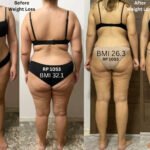
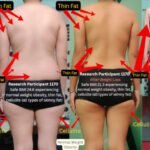
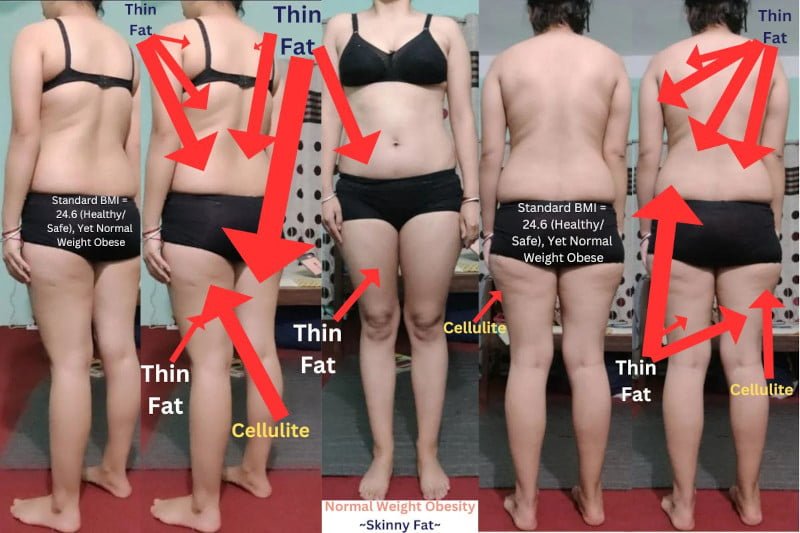
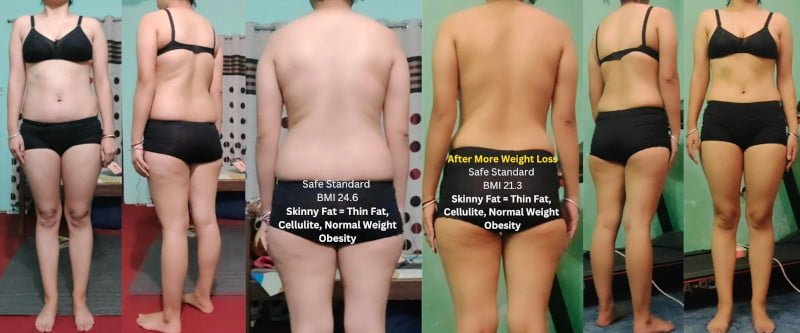
To date, the common gross assumption that all human beings are born in the same general genetic body relative to height and gender is the norm. Thus, as the gross assumption goes, all human beings have the same general level of genetic muscle tissue and body shape. Regardless of the fact that no science exists to support this common gross assumption. There is no scientific measure to determine total genetic muscle tissue or genetic muscle deficiency, let alone any way to diagnose skinny fat (lack of genetic muscle)(1, 2, 3, 4, 5).
Beyond the Number on the Scale: How a Genetic Muscle Deficiency (Skinny Fat) Impacts Metabolism and Health

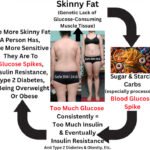
If there were a standard scientific/medical way to accurately measure total genetic muscle tissue, including deficiency and skinny fat, it would greatly improve understanding of metabolism, along with diet, exercise, and lifestyle choices. Muscle tissue positively affects metabolism (6) by burning more calories (energy). As the body’s main glucose uptake tissue (4), muscle helps regulate blood sugar (glucose) levels. The more muscle tissue you have, the more glucose (calories) it requires to function. Even at rest. And, thus, the more calories you burn.
The less muscle tissue a person has, the fewer calories their body burns — when active or at rest. And the more sensitive to glucose they are, especially blood sugar spikes from ultra-processed (UPF), fast, and junk food. Such food makes up 60%+ (7, 8, 9) of the average American’s daily diet. That number increases (10, 11) during the holidays. All of which directly affects (12) insulin resistance, type 2 diabetes, being overweight, and obesity. While the obesity epidemic festers, as the skinny fat crisis, mental health crisis, and human health, in general, get worse.
Right now, when you go see your doctor, the best they can do is grossly estimate your total genetic muscle tissue, any muscle mass added via resistance/exercise, and any muscle lost due to atrophy and/or sarcopenia. Hence, the Standard BMR/TDEE calorie calculation they offer is not accurate. All of it grossly, falsely assumes that each human body is generally the same. Just as most of the advice they give on diet, exercise, and lifestyle is inaccurate. Yet, any regular fat weight that you gain is not their fault. It is your fault. Imagine what life would be like if your doctor could accurately measure your body composition, particularly total genetic muscle tissue and potential deficiency, while being able to diagnose any skinny fat. As well as provide accurate metabolism, diet, exercise, and lifestyle guidance.
How a Genetic Muscle Deficiency (Skinny Fat) Impacts Metabolism and Health – The Solution
Instead, the highly controversial and inaccurate Standard BMI remains the go-to measure of body composition, while outdated BMR/TDEE calculations and dubious diet, exercise, and lifestyle information continue. Our MRI Study (5) is working on developing the first-ever total genetic muscle tissue measurement, an average muscle tissue measurement to compare it to (IE, is your genetic muscle average, above average, or below average), and the ability to diagnose skinny fat. We are also developing an accurate science-based metabolism, diet, exercise, and lifestyle database.
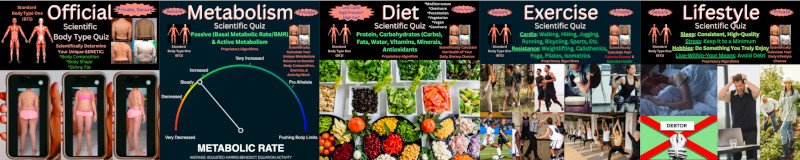
Moreover, we have wrangled the latest science to develop the Scientific Health Quizzes. The Scientific Body Type Quiz focuses on body composition to determine body shape and skinny fat, at least. At the same time, the Scientific Metabolism Quiz, Scientific Diet Quiz, Scientific Exercise Quiz, and Scientific Lifestyle Quiz help you better understand the best health choices for your unique body. Accounts are free, private, secure, and anonymous. Free options are available.
References
- Skinny Fat Science: What Is Skinny Fat?, July 26, 2024. https://skinnyfat.fellowone.com/skinny-fat-science/what-is-skinny-fat/
- Skinny Fat Science: Skinny Fat is a Lack of Genetic Muscle – Beyond Normal-Weight Obesity, August 13, 2025. https://skinnyfat.fellowone.com/skinny-fat-science/skinny-fat-is-a-lack-of-genetic-muscle-beyond-normal-weight-obesity/
- Skinny Fat Science: Is Skinny Fat Genetic?, November 27, 2024. https://skinnyfat.fellowone.com/skinny-fat-science/is-skinny-fat-genetic/
- Skinny Fat Science: Is Muscle/Mass Genetic and How Does It Affect Skinny Fat?, November 20, 2024. https://skinnyfat.fellowone.com/skinny-fat-science/is-muscle-mass-genetic-and-how-does-it-affect-skinny-fat/
- Skinny Fat Science: Scientific Skinny Fat MRI Study – Proving What Skinny Fat Is, March 26, 2025. https://skinnyfat.fellowone.com/skinny-fat-science/scientific-skinny-fat-mri-study-proving-what-skinny-fat-is/
- Skinny Fat Science: How Skinny Fat Affects Metabolism, August 7, 2025. https://skinnyfat.fellowone.com/skinny-fat-science/how-skinny-fat-affects-metabolism/
- Stanford Medicine: Ultra-processed food: Five things to know, July 15, 2025, John Sanford. https://med.stanford.edu/news/insights/2025/07/ultra-processed-food–five-things-to-know.html
- Johns Hopkins, Bloomberg School of Public Health: Most of the Foods We Eat Are Ultra-Processed. Are They All Unhealthy?, November 10, 2025, Morgan Coulson. https://publichealth.jhu.edu/2025/what-are-ultra-processed-foods
- NIH, National Lung, Heart, and Blood Institute: Spotlight on UPFs: NIH explores link between ultra-processed foods and heart disease, March 5, 2025. https://www.nhlbi.nih.gov/news/2025/spotlight-upfs-nih-explores-link-between-ultra-processed-foods-and-heart-disease
- ResearchGate: New Year’s Res-Illusions: Food Shopping in the New Year Competes with Healthy Intentions, December 2014, Lizzy Pope, Andrew Hanks, David R. Just, and Brian Wansink. https://www.researchgate.net/publication/269766418_New_Year’s_Res-Illusions_Food_Shopping_in_the_New_Year_Competes_with_Healthy_Intentions
- The Guardian: ‘It’s about balancing out December’: why nutritionists overindulge at Christmas too, December 1, 2024, Nicola Davis. https://www.theguardian.com/society/2024/dec/01/its-about-balancing-out-december-why-nutritionists-overindulge-at-christmas-too
- Skinny Fat Science: Skinny Fat & Insulin Resistance, June 4, 2025. https://skinnyfat.fellowone.com/skinny-fat-science/skinny-fat-insulin-resistance/
Was this article helpful?
Related Posts
What Is Skinny Fat?
How to Fix Skinny Fat
The Best Skinny Fat Diet, According to Science

Popular Concepts
- What Body Fat Percentage Is Skinny Fat?

- Skinny Fat Body Composition – Before & After Weight Loss
- Skinny Fat Genetics, Race DNA, and Muscle Tissue
- Skinny Fat & Insulin Resistance
- Body Dysmorphia and Skinny Fat Including Anorexia & Other Eating Disorders
- How Skinny Fat Affects Body Shape
- Skinny Fat Is More Than Just Normal-Weight Obesity